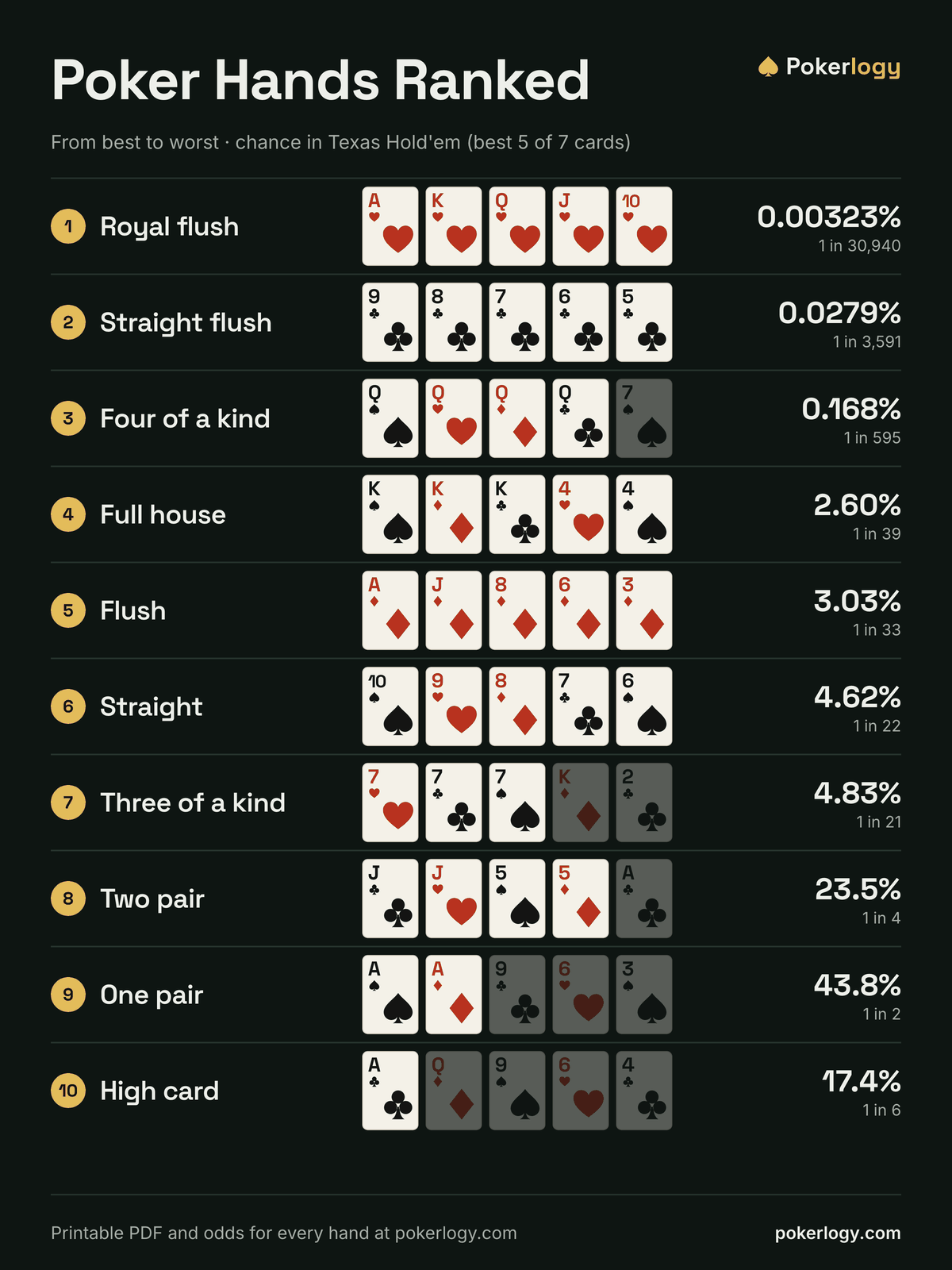
From best to worst, the ten poker hands are: royal flush, straight flush, four of a kind, full house, flush, straight, three of a kind, two pair, one pair and high card. Any hand higher on this list beats any hand below it, and only your best five cards count.
Download for free
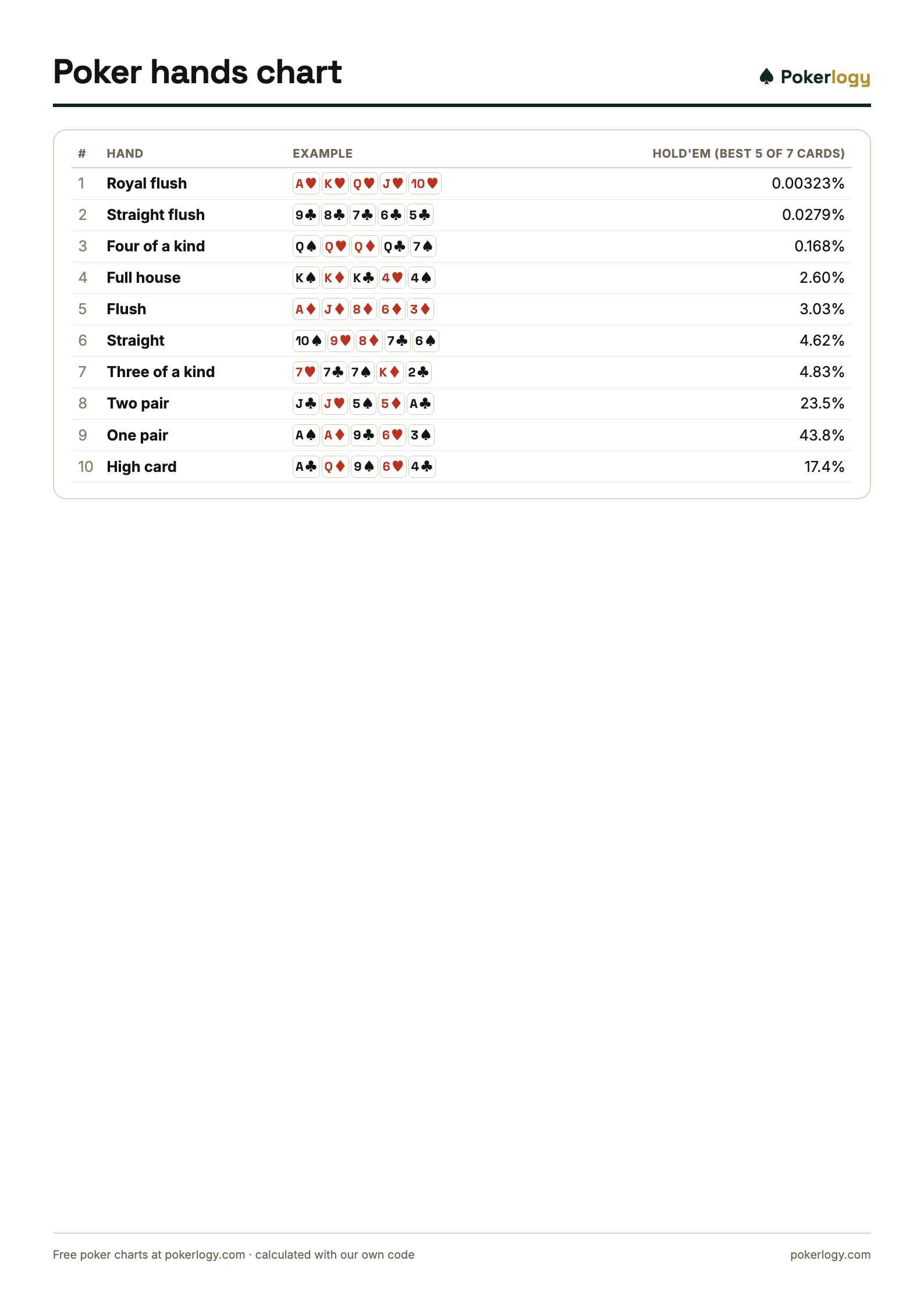
No e-mail, no account. Print it or keep it on your phone.
How often does each hand come up?
The ranking is not arbitrary. A 52-card deck can produce 2,598,960 different five-card hands, and the fewer ways there are to make a hand, the higher it ranks. The last two columns show how often you end up with each hand in Texas Hold’em, where you use the best five of seven cards.
| Hand | Example | Combinations (5 cards) | Chance with 5 cards | Chance in Hold’em (best 5 of 7 cards) | About 1 in… (Hold’em) |
|---|---|---|---|---|---|
| Royal flush | 4 | 0.000154% | 0.00323% | 30,940 | |
| Straight flush | 36 | 0.00139% | 0.0279% | 3,591 | |
| Four of a kind | 624 | 0.0240% | 0.168% | 595 | |
| Full house | 3,744 | 0.144% | 2.60% | 39 | |
| Flush | 5,108 | 0.197% | 3.03% | 33 | |
| Straight | 10,200 | 0.392% | 4.62% | 22 | |
| Three of a kind | 54,912 | 2.11% | 4.83% | 21 | |
| Two pair | 123,552 | 4.75% | 23.5% | 4 | |
| One pair | 1,098,240 | 42.3% | 43.8% | 2 | |
| High card | 1,302,540 | 50.1% | 17.4% | 6 |
Straight flushes do not include royal flushes, and flushes and straights do not include straight flushes. Faded cards are side cards that are not part of the hand.
What are the ten poker hands, one by one?
1. Royal flush
Ace, king, queen, jack and ten of the same suit: the highest straight flush. Nothing beats it, and it beats every other hand. Two royal flushes can only meet when all five cards are on the board, and then the pot is split. A common mistake is to think a royal flush in spades beats one in hearts. Suits are never ranked. The exact odds are on our royal flush odds page. More about the royal flush →
2. Straight flush
Five cards in sequence, all of the same suit. Only a royal flush or a higher straight flush beats it, and it beats four of a kind and everything below. The lowest one is 5-4-3-2-A of one suit. Beginners sometimes count K-A-2-3-4 as a straight flush, but the ace cannot connect a king to a two. See the straight flush odds for how rare it is. More about the straight flush →
3. Four of a kind
Four cards of the same rank, also called quads. It loses only to a straight flush and beats a full house and below. Higher quads beat lower ones. When the four matching cards are all on the board, every player shares them, and the highest fifth card wins. Forgetting that fifth card is the usual mistake in that spot. More about four of a kind →
4. Full house
Three of a kind plus a pair, sometimes called a boat. It loses to four of a kind and beats a flush. Compare the three matching cards first: kings full of fours beats queens full of aces. Remember that a full house needs a pair on the board in Hold’em, so when the board pairs, your flush may no longer be the best hand. More about the full house →
5. Flush
Five cards of the same suit, not in sequence. It loses to a full house and beats a straight. Between two flushes, the highest card wins, then the second highest, down to the fifth. Four cards of one suit are not a flush, only a flush draw, and the suit itself never breaks a tie. More about the flush →
6. Straight
Five cards in sequence in two or more suits. It loses to a flush and beats three of a kind. The ace plays high in 10-J-Q-K-A, called Broadway, or low in A-2-3-4-5, the wheel, but it cannot sit in the middle, so Q-K-A-2-3 is not a straight. Two straights with the same top card tie. More about the straight →
7. Three of a kind
Three cards of the same rank and two side cards. It loses to a straight and beats two pair. In Hold’em, a pocket pair plus one matching board card is called a set, while one card in your hand plus a pair on the board is trips. With trips, your kicker often decides the pot, so do not overvalue a weak one. More about three of a kind →
8. Two pair
Two pairs of different ranks and one side card. It loses to three of a kind and beats one pair. Compare the higher pairs first, then the lower pairs, then the fifth card. With seven cards you can hold three pairs, but only the two highest count. A pair on the board can also “counterfeit” your lower pair. More about two pair →
9. One pair
Two cards of the same rank and three side cards. It loses to two pair and beats high card. It is the most common final hand in Hold’em, at 43.8% of deals, so the size of your pair and your kicker matter constantly. Ace-king beats ace-queen on an ace-high board because of the kicker, not the pair. More about one pair →
10. High card
Five cards that make none of the hands above. It beats nothing and loses to any pair. The highest card wins, then the next one down, and so on. A frequent mistake is to look only at the single highest card: if both players have ace-high, the second, third and later cards decide. More about high card →
How do you make a hand in Texas Hold’em?
You combine your two hole cards with the five cards on the board and use any five of those seven. You can use both hole cards, one, or none at all.
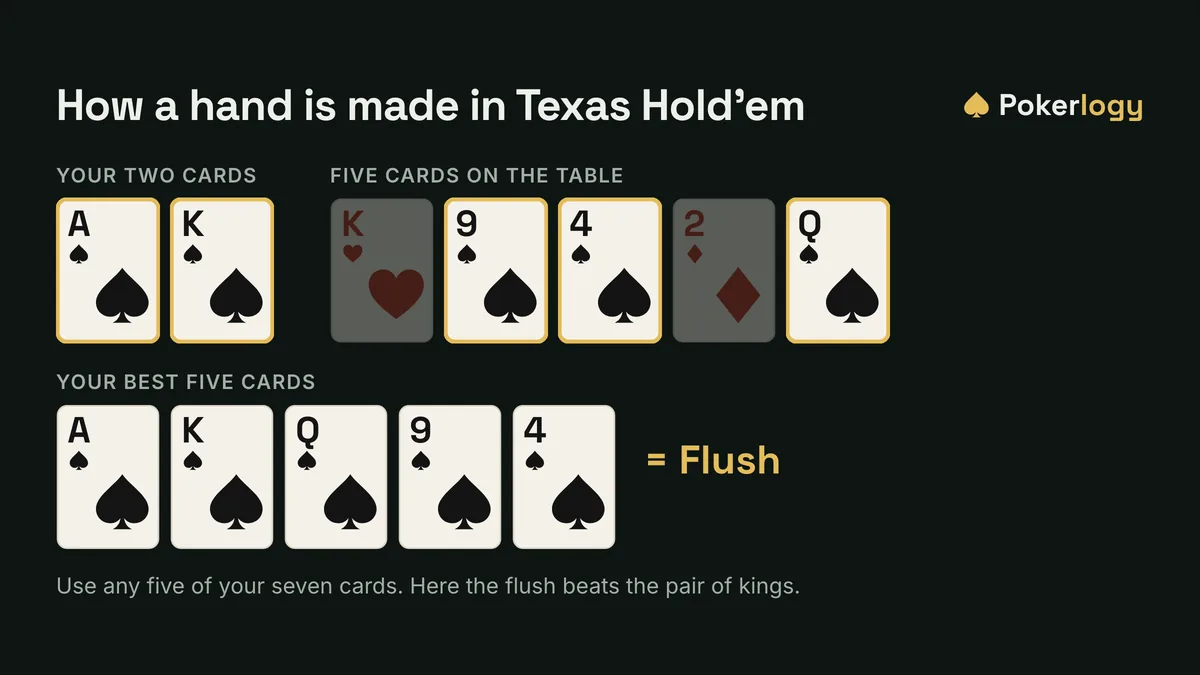
In this example, A♠ K♠ with three spades on the board makes an ace-high flush. The pair of kings is still there, but the flush is the stronger five-card hand, so that is what you play.
What beats what in poker?
These are the matchups beginners mix up most. In every case the rarer hand wins.
| Matchup | Winner | Why (5-card combinations) |
|---|---|---|
| Flush vs straight | Flush | 5,108 vs 10,200 |
| Full house vs flush | Full house | 3,744 vs 5,108 |
| Full house vs straight | Full house | 3,744 vs 10,200 |
| Four of a kind vs full house | Four of a kind | 624 vs 3,744 |
| Straight vs three of a kind | Straight | 10,200 vs 54,912 |
| Flush vs three of a kind | Flush | 5,108 vs 54,912 |
| Three of a kind vs two pair | Three of a kind | 54,912 vs 123,552 |
| Straight vs two pair | Straight | 10,200 vs 123,552 |
Example: you hold K♦ 8♦ and the board has three diamonds. Your opponent shows an ace-high straight. You win: a flush is one step above a straight, however high the straight is.
How are ties and kickers decided?
When two players have the same kind of hand, the cards inside it decide. Suits never break a tie, and only five cards count, so a sixth or seventh card can never play as a kicker.
| Hand | How a tie is broken |
|---|---|
| Straight flush, straight | Highest card of the sequence (the wheel’s top card is the 5) |
| Four of a kind | Rank of the four, then the fifth card |
| Full house | Rank of the three, then the pair |
| Flush, high card | Highest card, then the next, down to the fifth |
| Three of a kind | Rank of the three, then the two side cards |
| Two pair | Higher pair, lower pair, then the fifth card |
| One pair | Rank of the pair, then the three side cards one by one |
A kicker is a side card that is not part of your pair, three of a kind or four of a kind. If the best five cards are identical, the pot is split. Our guide to showdowns and split pots has more examples.
Why are 5-card and 7-card odds different?
With seven cards you get two extra chances to complete something. A royal flush comes once in 649,740 five-card hands but about once in 30,940 Hold’em deals, and a full house jumps from 0.144% to 2.60%. Only high card becomes rarer: half of all five-card hands have no pair, but with seven cards that happens in just 17.4% of deals.
The ranking still follows the five-card numbers. That is why a straight outranks three of a kind even though, in Hold’em, they come up almost equally often (4.62% and 4.83%). We counted every one of the 2,598,960 five-card and 133,784,560 seven-card combinations with our own code and the open-source eval7 evaluator, so these are exact counts, not simulations. More numbers are on the poker odds chart and the flop odds page.
Who wins in these three example hands?
Example 1: same pair, different kicker
The board is . Player A holds and player B holds . Both have a pair of kings, so the kicker decides: A’s ace beats B’s queen. Player A wins with K-K-A-9-7 against K-K-Q-9-7.
Example 2: flush against straight
The board is . Player A holds and makes a ten-high straight. Player B holds and makes an ace-high flush. A flush beats a straight, so player B wins.
Example 3: your pair does not play
The board is . Player A holds and player B holds . A hand is only five cards, so both players’ best hand is the board: aces and kings with a queen. The jacks do not play, and the pot is split.
How can you check who wins a hand?
Enter any hands and board in our poker hand calculator to see who wins and with which five cards. To see each player’s chances before all the cards are out, use the poker odds calculator.
Do other poker games use different hand rankings?
The order above applies in Texas Hold’em, Omaha, seven-card stud and five-card draw. A few games change it.
- Omaha: the ranking is the same, but you must use exactly two of your four hole cards and three from the board.
- Short deck: the twos through fives are removed, so a flush becomes harder to make than a full house. In short deck poker a flush beats a full house.
- Lowball: the worst hand wins. In Razz the best hand is 5-4-3-2-A, and in 2-7 Triple Draw it is 7-5-4-3-2 with no flush.
- Hi-Lo: in Omaha Hi-Lo the pot is split between the best high hand and the best qualifying low hand.
What do players ask most often?
Does a flush beat a straight?
Yes, a flush beats a straight. There are 5,108 ways to make a flush and 10,200 ways to make a straight among all 2,598,960 five-card hands, so the flush is about twice as rare. It does not matter how high the straight is: the lowest flush still beats Broadway.
Does a full house beat a flush?
Yes, a full house beats a flush in standard poker. There are 3,744 full houses and 5,108 flushes, so the full house is rarer. The one common exception is short deck Hold’em, where the low cards are removed and a flush ranks above a full house.
Does a straight beat three of a kind?
Yes, a straight beats three of a kind. A straight has 10,200 five-card combinations and three of a kind has 54,912, so the straight is more than five times rarer. In Texas Hold’em the two come up almost equally often, but the ranking always follows the five-card numbers.
Does two pair beat three of a kind?
No, three of a kind beats two pair. It feels odd because two pair uses four matching cards, but there are 123,552 ways to make two pair and only 54,912 ways to make three of a kind. The rarer hand always ranks higher.
What is the best hand in poker?
The royal flush is the best hand in poker: ace, king, queen, jack and ten of the same suit. Only four of the 2,598,960 possible five-card hands are royal flushes, one per suit. In Texas Hold’em you make one about once in every 30,940 deals.
What is the worst hand in poker?
The worst five-card hand is 7-5-4-3-2 in mixed suits, a seven-high with no pair, straight or flush. Among Hold’em starting hands, 7-2 offsuit is usually called the worst, because it can hardly make a straight or flush and its high card is weak.
Do suits matter in poker?
No, card suits do not matter in standard poker hand rankings. Spades, hearts, diamonds and clubs are equal, so two hands that differ only in suits tie and split the pot. Suits matter only for making a flush, where all five cards must share one suit.
What happens if two players have the same hand?
If two players have the same type of hand, the ranks of the cards inside it decide, then the kickers, from the highest down. If both players’ best five cards are identical in rank, the pot is split equally. A sixth or seventh card never counts as a kicker.
Where to go next?
- Starting hands chart: which two cards to play before the flop.
- Poker cheat sheet: hand rankings, outs and pot odds on one printable page.
- Poker odds calculator: your chance to win with any cards.
- Texas Hold’em rules: how a hand is dealt and played, step by step.