This poker cheat sheet fits everything a beginner needs on one printable page: the ten hands in order, the strongest starting hands, where to sit, how to count outs and how to read pot odds. Download it below, then read on for a short explanation of each block so you know what the numbers mean.
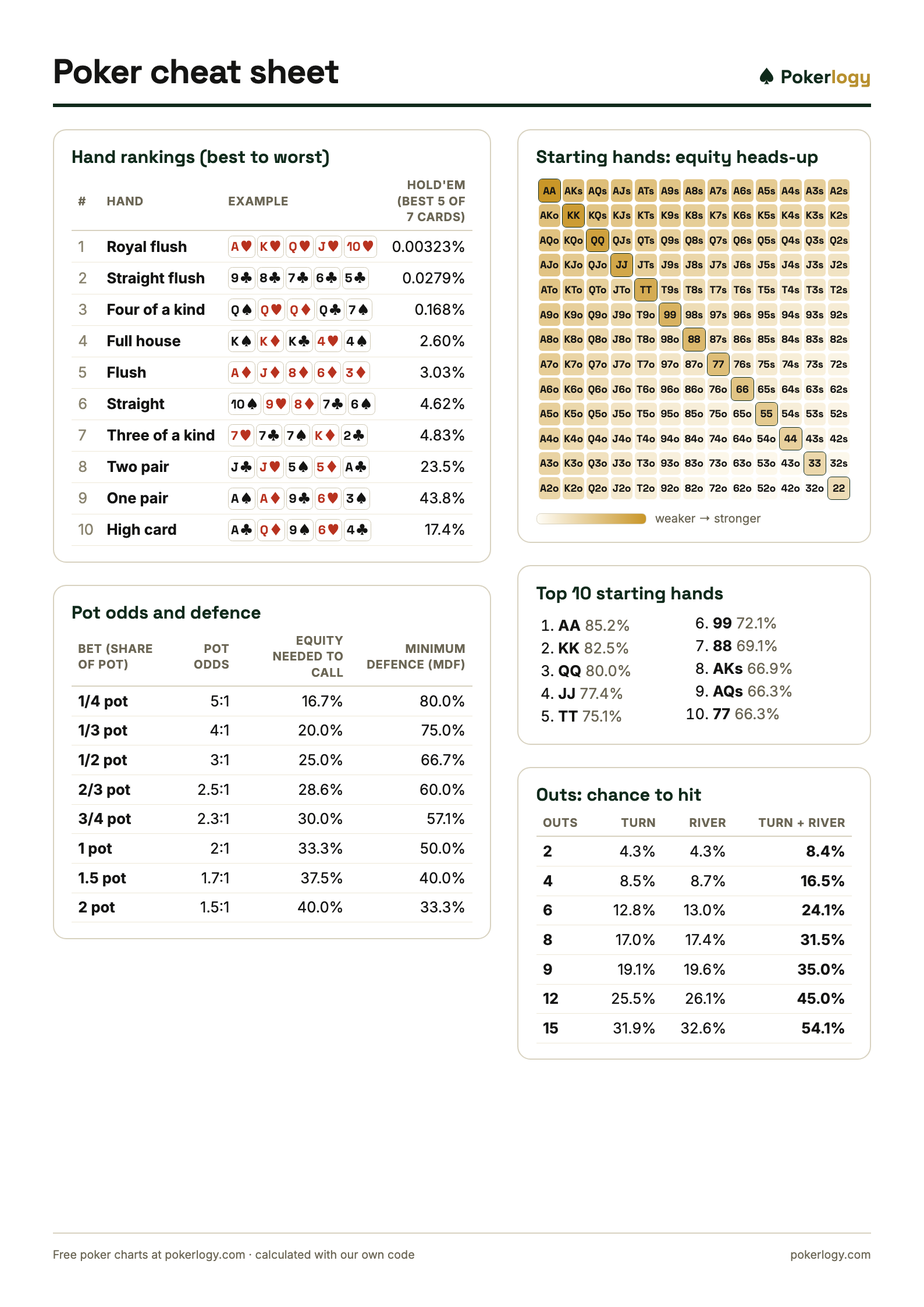
Download for free
No e-mail, no account. Print it or keep it on your phone.
What is on the poker cheat sheet?
The sheet has five blocks, from the most basic to the most useful once you are comfortable with the rules:
- hand rankings, so you always know what beats what;
- the strongest starting hands, so you know which two cards are worth playing;
- position basics, so you know why your seat matters;
- outs and the rule of 2 and 4, so you can estimate how often a draw comes in;
- pot odds, so you can tell whether a call is worth its price.
All the numbers are for Texas Hold’em, the game most people learn first, but the hand rankings work in almost every poker variant.
Which poker hands beat which?
Every poker hand is made of five cards. In Hold’em you pick the best five out of your two hole cards and the five community cards. From strongest to weakest:
- Royal flush: A-K-Q-J-10 of one suit.
- Straight flush: five in a row, same suit.
- Four of a kind: four cards of one rank.
- Full house: three of a kind plus a pair.
- Flush: five cards of one suit.
- Straight: five in a row, mixed suits.
- Three of a kind: three cards of one rank.
- Two pair: two different pairs.
- One pair: two cards of one rank.
- High card: none of the above.
Two things trip up beginners most often. First, a flush beats a straight. Second, when two players have the same hand, the remaining cards decide, and the highest unpaired card is called the kicker. Our poker hands chart adds the odds of each hand, and the full rules for ties are in showdown rules.
What are the best starting hands in Texas Hold’em?
Before the flop you only see two cards, so the question is how often they end up as the best hand. We ranked all 169 starting hands by their equity, the share of the pot a hand wins on average when the cards are dealt out to the river. Here are the top 10 heads-up (against one random hand):
| Rank | Hand | Equity vs 1 hand |
|---|---|---|
| 1 | A-A | 85.2% |
| 2 | K-K | 82.5% |
| 3 | Q-Q | 80.0% |
| 4 | J-J | 77.4% |
| 5 | 10-10 | 75.1% |
| 6 | 9-9 | 72.1% |
| 7 | 8-8 | 69.1% |
| 8 | A-K suited | 66.9% |
| 9 | A-Q suited | 66.3% |
| 10 | 7-7 | 66.3% |
Against many opponents the list changes. With nine random hands at the table, the top 10 is A-A, K-K, Q-Q, A-K suited, J-J, A-Q suited, K-Q suited, A-J suited, K-J suited and A-10 suited. Middle pairs drop down because they rarely improve, while high suited cards climb because they can make flushes and straights. On the sheet we combine both lists into simple tiers:
- Premium: A-A, K-K, Q-Q, J-J, A-K suited. The top five against nine opponents, and all in the top eight heads-up.
- Strong: 10-10, A-K offsuit, A-Q suited, A-J suited, A-10 suited, K-Q suited.
- Good: 9-9, 8-8, 7-7, A-Q offsuit, A-J offsuit, K-J suited, Q-J suited, J-10 suited.
“Suited” means both cards share a suit, like , and “offsuit” means they do not, like . Every hand is ranked on the starting hands chart.
Why does your position at the table matter?
After the flop, players act in turn, and the player on the button acts last. Acting last is a big advantage: you see what everyone else does before you decide. That is why the same two cards are worth more in late position than in early position.
- Early position (under the gun and the seat after it): many players still to act behind you, so play only your strongest hands.
- Middle position: you can add a few more hands from the Strong and Good tiers.
- Late position (the cutoff and the button): the best seats. You can play the widest range.
- The blinds: you have already put chips in, but you act first after the flop, which makes these the hardest seats to play well.
The full picture, with diagrams for nine-handed, six-max and heads-up tables, is in our guide to poker positions.
How do you count outs and use the rule of 2 and 4?
Outs are the unseen cards that would improve your hand to the likely winner. With four cards to a flush after the flop, nine cards of that suit are left, so you have 9 outs. To turn outs into a percentage, multiply by 4 on the flop (two cards to come) or by 2 on the turn (one card to come).
| Outs | Typical draw | Flop to river (rule / exact) | Turn to river (rule / exact) |
|---|---|---|---|
| 4 | Gutshot | 16% / 16.5% | 8% / 8.7% |
| 8 | Open-ended straight draw | 32% / 31.5% | 16% / 17.4% |
| 9 | Flush draw | 36% / 35.0% | 18% / 19.6% |
| 15 | Flush draw plus straight draw | 60% / 54.1% | 30% / 32.6% |
The rule is close enough for most draws, but it overshoots when you have a lot of outs. The complete table for 1 to 20 outs is on the poker odds chart.
What are pot odds and how do you read them?
Pot odds compare what you must call with what you can win. Say the pot is 100 chips and your opponent bets 50. The pot is now 150, you need to call 50, and if you win you collect 200 in total. Your call is a quarter of the final pot, so you need to win at least 25% of the time to break even. The table below does this for common bet sizes:
| Bet (share of pot) | Pot odds | Equity needed to call | Minimum defence (MDF) | Bluff must work (alpha) |
|---|---|---|---|---|
| 1/4 pot | 5:1 | 16.7% | 80.0% | 20.0% |
| 1/3 pot | 4:1 | 20.0% | 75.0% | 25.0% |
| 1/2 pot | 3:1 | 25.0% | 66.7% | 33.3% |
| 2/3 pot | 2.5:1 | 28.6% | 60.0% | 40.0% |
| 3/4 pot | 2.3:1 | 30.0% | 57.1% | 42.9% |
| 1 pot | 2:1 | 33.3% | 50.0% | 50.0% |
| 1.5 pot | 1.7:1 | 37.5% | 40.0% | 60.0% |
| 2 pot | 1.5:1 | 40.0% | 33.3% | 66.7% |
To use it, compare the “equity needed to call” column with your chance of winning. If your flush draw has 19.6% on the turn and your opponent bets half the pot, you need 25.0%, so the price is too high on its own. If they bet a quarter of the pot, you need only 16.7%, and calling is fine. The last two columns are for the bettor and the defender: MDF says how often you should continue so that bluffs do not profit automatically, and alpha says how often a bluff of that size must work to break even.
How did we calculate these numbers?
Every number on the sheet comes from our own code using the open-source eval7 hand evaluator. Starting hand equities against random hands come from 300,000 simulated deals per hand and number of opponents, with ties split, so they are accurate to about ±0.2 percentage points. Outs, pot odds and hand probabilities are exact, calculated with combinatorics: there are 2,598,960 possible five-card hands and 133,784,560 seven-card combinations. Updated 14 November 2026.
What do players ask most often?
Is a poker cheat sheet allowed at the table?
At a friendly home game, ask the others first. Most players are happy to let a beginner keep one nearby. In clubs and tournaments, written aids at the table are usually not allowed, so learn the key numbers at home.
Which hand is stronger, a flush or a straight?
A flush. There are 5,108 ways to make a flush with five cards and 10,200 ways to make a straight, and the rarer hand ranks higher.
What is the best starting hand in Texas Hold’em?
Pocket aces. Against one random hand, A-A wins 85.2% of the pot on average, and it stays the best hand against any number of opponents.
Why do the starting hands change with more players?
Against many opponents a hand usually needs to improve to win. Suited and connected cards can make flushes and straights, while a hand like 7-7 rarely improves beyond one pair.
Do I need to memorise the whole sheet?
No. Learn the hand rankings first, then the rule of 2 and 4. The rest you can look up until it becomes second nature.