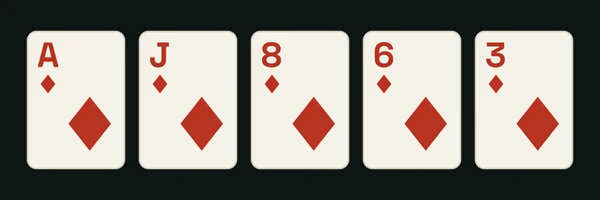
A flush is any five cards of the same suit that are not in sequence, such as , an ace-high flush. It ranks fifth of the ten poker hands, below the full house and above the straight.
What beats a flush?
A flush loses to a full house, four of a kind, a straight flush and a royal flush, and to a higher flush. The full house is the one that catches most players out: there are 3,744 five-card full houses and 5,108 flushes, so the full house is rarer and wins. The exception is short deck Hold’em, where the twos through fives are removed, flushes get harder to make, and a flush beats a full house.
What does a flush beat?
A flush beats a straight, three of a kind, two pair, one pair and high card. Flush vs straight is the most common question: a flush has 5,108 combinations and a straight 10,200, so the flush is about twice as rare and always wins. Even a seven-high flush beats Broadway, the ace-high straight.
What are the odds of getting a flush?
| Measure | Flush |
|---|---|
| Combinations (5 cards, out of 2,598,960) | 5,108 |
| Chance with 5 cards | 0.197% |
| About 1 in… (5 cards) | 509 |
| Chance in Hold’em (best 5 of 7 cards) | 3.03% |
| About 1 in… (Hold’em) | 33 |
These numbers leave out straight flushes and royal flushes. In Hold’em, four cards of one suit after the flop or turn are a flush draw, with nine outs left in the deck. How often a draw gets there is covered on the flop odds page.
How is a tie between two flushes decided?
Compare the highest card of each flush. If those match, compare the second highest, then the third, down to the fifth. A-J-8-6-3 beats A-10-9-8-7 because the jack beats the ten. Only five cards count, so a sixth card of the suit never plays. If all five ranks match, the pot is split: suits never break ties, and a spade flush is not better than a heart flush.
Who wins in these examples?
Example 1: flush against straight
The board is . Player A holds and makes a jack-high straight, J-10-9-8-7. Player B holds and makes a nine-high flush, 9-8-5-4-2 of clubs. A flush beats a straight, so player B wins with the lower-looking cards.
Example 2: four of a suit on the board
The board is . Player A holds and makes K-Q-9-7-4 of hearts. Player B holds and makes K-9-8-7-6 of hearts. Both flushes are king-high, so the second card decides: A’s queen beats B’s nine, and player A wins even though B used two hearts.
Example 3: flush against full house
The board is . Player A holds and makes the ace-high flush, A-J-8-6-4 of diamonds. Player B holds and makes eights full of jacks. On a paired board, the full house beats the flush, so player B wins.
What mistakes do beginners make with a flush?
- Counting four cards as a flush. Four of a suit is only a draw. You need five.
- Thinking the suit matters. Spades, hearts, diamonds and clubs are equal. Two flushes with the same ranks tie.
- Ignoring a paired board. In Hold’em, a full house needs a pair on the board. When the board pairs, your flush can be beaten.
- Overvaluing a low flush. When the board shows four cards of one suit, anyone with one higher card of that suit beats you. Only the nut flush, the highest flush possible on that board, cannot lose to another flush.
- Applying short deck rules to Hold’em, or the other way round. A flush beats a full house only in short deck.
Common flush slang: the “nut flush” is the highest flush possible on the board (see nuts), a “backdoor flush” is completed with both the turn and the river, and a “four-flush” is four cards of one suit.
What do players ask about the flush?
Does a flush beat a straight?
Yes, a flush beats a straight in every standard poker game. There are 5,108 five-card flushes and 10,200 straights, so the flush is about twice as rare. It does not matter how high the straight is: a seven-high flush still beats an ace-high straight.
Does a flush beat a full house?
No, a full house beats a flush in standard poker, including Texas Hold’em and Omaha. A full house has 3,744 five-card combinations against 5,108 for a flush. The exception is short deck Hold’em, played without the twos through fives, where a flush is harder to make and ranks above a full house.
Who wins if two players have a flush?
The player with the highest card in their flush wins. If those cards match, the next highest are compared, down to the fifth card. If all five ranks are the same, the pot is split, because suits never break ties and a sixth suited card never counts.
What is the best possible flush?
The best flush that is not a straight flush is A-K-Q-J-9 of one suit. Any higher combination of five suited cards, A-K-Q-J-10, would be a royal flush. In Hold’em, the best flush available on a given board is called the nut flush.
The flush is fifth in the list of all poker hands ranked. One step up is the full house, one step down is the straight. In Texas Hold’em you make one with your two hole cards and the board; check any matchup in the poker hand calculator or with the poker odds calculator.
Head-to-head: Does a flush beat a full house? · Does a flush beat a straight? · Does a flush beat three of a kind?