One pair is a hand with two cards of the same rank and three unrelated side cards, such as A-A-9-6-3. It is the ninth of the ten poker hands, second from the bottom: it beats only high card and loses to two pair and everything above.
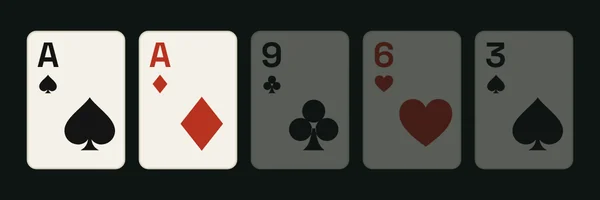
One pair is the most common final hand in Texas Hold’em, at 43.8% of all deals. Because so many showdowns are pair against pair, the size of your pair and your kicker decide more pots than any other detail.
What beats one pair?
Eight hands beat one pair: two pair, three of a kind, a straight, a flush, a full house, four of a kind, a straight flush and a royal flush. A higher pair also beats a lower one, and the same pair with a better kicker wins.
What does one pair beat?
One pair beats only high card. Even a pair of twos beats ace-king-queen-jack-nine with no pair.
What are the odds of getting one pair?
| Measure | One pair |
|---|---|
| Combinations (5 cards, out of 2,598,960) | 1,098,240 |
| Chance with 5 cards | 42.3% |
| About 1 in… (5 cards) | 2.4 |
| Chance in Hold’em (best 5 of 7 cards) | 43.8% |
| About 1 in… (Hold’em) | 2.3 |
The Hold’em figure counts one pair as the final hand, so deals that went on to make two pair or better are not included. An unpaired starting hand flops a pair or better 32.4% of the time, and you are dealt a pocket pair once in 17 hands; see the flop odds and pocket pair odds.
How is a tie between two pairs decided?
The higher pair wins. If both players hold the same pair, compare the three side cards one at a time, from the highest down: the first one that differs decides. If all three match, the pot is split. Suits never count, and only five cards play, so your sixth and seventh cards can never act as a kicker.
Who wins in these example hands?
Example 1: same pair, better kicker
The board is . Player A holds and player B holds . Both have a pair of aces. A plays A-A-K-10-7, B plays A-A-Q-10-7. The king beats the queen, so player A wins.
Example 2: the kickers do not play
The board is . Player A holds and player B holds . Both play K-K-Q-9-6, because the board cards are higher than their own side cards. The four and the three never count, and the pot is split.
Example 3: overpair against top pair
The board is . Player A holds , an overpair to the board. Player B holds , top pair with the best kicker. Queens beat jacks, so player A wins; B’s ace kicker only matters against another pair of jacks.
What mistakes do beginners make with one pair?
- Ignoring the kicker. A-9 and A-K both make a pair of aces on an ace-high board, but A-9 loses to A-K every time.
- Counting a board pair as theirs. If the pair is on the board, every player has it.
- Thinking a sixth card is a kicker. Only five cards play.
- Overplaying one pair. Since it is the most common hand, a big bet against you often means two pair or better.
Slang: top pair (pairing the highest board card), middle and bottom pair, overpair and underpair. Pairs have nicknames too: aces are “pocket rockets”, kings “cowboys”, queens “ladies” and twos “ducks”.
What do players ask about one pair?
What is the most common hand in Texas Hold’em?
One pair is the most common final hand in Texas Hold’em, at 43.8% of deals. Two pair comes next at 23.5%, then high card at 17.4%. With five cards, though, high card is slightly more common than one pair, at 50.1% against 42.3%.
What is a kicker in poker?
A kicker is a side card that is not part of your pair, three of a kind or four of a kind. When two players hold the same pair, the kickers are compared from the highest down. For example, A-A-K beats A-A-Q, even though both players have aces.
Does a pair of aces beat two pair?
No, any two pair beats a pair of aces. Two pair ranks one step above one pair, so even threes and twos beat the highest single pair. Pocket aces are the best starting hand, but they still need to improve or stay ahead.
What happens if two players have the same pair and kickers?
If two players have the same pair and the same three side cards in rank, the pot is split equally. Suits never break the tie, and cards beyond the best five do not count, so a higher sixth card in your hand makes no difference.
Return to all poker hands ranked for the full order. One step up is two pair, one step down is high card. Learn which pairs and kickers are worth playing on the starting hands chart and with pocket aces, and check any showdown in the poker hand calculator.