This poker odds chart collects the numbers you need most often in Texas Hold’em: how likely your draw is to come in, what price you are getting on a call, how the classic preflop all-ins play out, and how often you are dealt or flop common hands. You can download the whole set as a printable PDF at the end of the page.
How do you count your outs?
Outs are the unseen cards that would turn your hand into the likely winner. You count them by asking: which cards left in the deck complete my hand? Every card you have not seen counts as still in the deck: 47 after the flop, 46 after the turn.
Three draws come up again and again:
- Flush draw, 9 outs. You hold and the flop is . You have four hearts, and 13 − 4 = 9 hearts are left. See flush draw.
- Open-ended straight draw, 8 outs. You hold and the flop is . Any five or any ten makes a straight: 4 + 4 = 8 outs.
- Gutshot, 4 outs. You hold and the flop is . Only a jack fills the gap, and there are four of them. See gutshot.
When you have two draws at once, do not count the same card twice. With on you have 9 hearts for the flush plus 8 cards for the straight, but two of those straight cards (the 10♥ and the 5♥) are hearts you already counted. That leaves 9 + 6 = 15 outs.
What are the odds of hitting your outs?
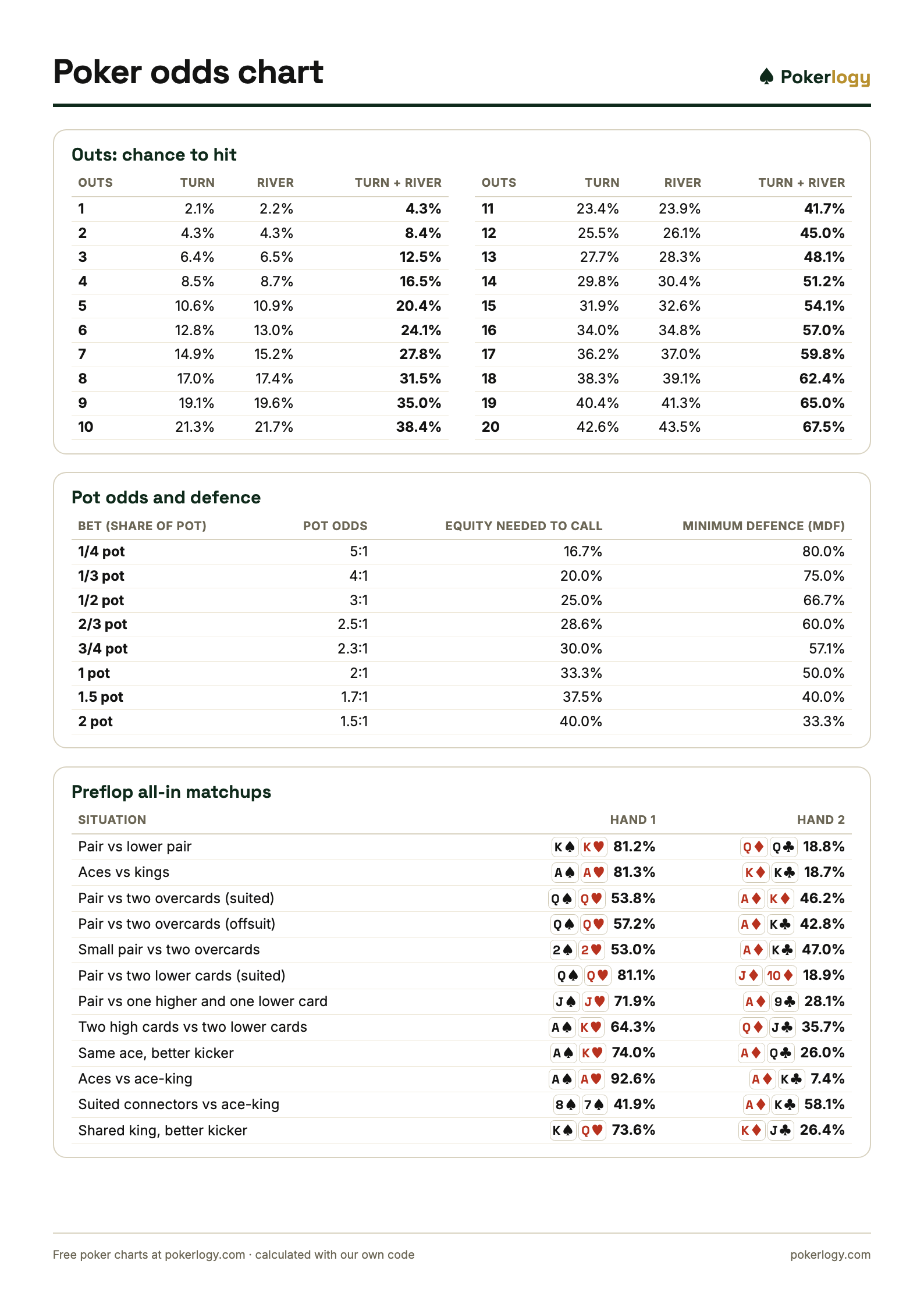
The table shows, for 1 to 20 outs, your chance of hitting on the turn alone, on the river alone (once the turn is out), on either card from the flop, the rule of 2 and 4 estimate, and the odds against hitting from flop to river.
| Outs | Turn | River | Turn + river | Rule of 2 / 4 | Odds against (flop to river) |
|---|---|---|---|---|---|
| 1 | 2.1% | 2.2% | 4.3% | 2 / 4 | 22.5 : 1 |
| 2 | 4.3% | 4.3% | 8.4% | 4 / 8 | 10.9 : 1 |
| 3 | 6.4% | 6.5% | 12.5% | 6 / 12 | 7.0 : 1 |
| 4 | 8.5% | 8.7% | 16.5% | 8 / 16 | 5.1 : 1 |
| 5 | 10.6% | 10.9% | 20.4% | 10 / 20 | 3.9 : 1 |
| 6 | 12.8% | 13.0% | 24.1% | 12 / 24 | 3.1 : 1 |
| 7 | 14.9% | 15.2% | 27.8% | 14 / 28 | 2.6 : 1 |
| 8 | 17.0% | 17.4% | 31.5% | 16 / 32 | 2.2 : 1 |
| 9 | 19.1% | 19.6% | 35.0% | 18 / 36 | 1.9 : 1 |
| 10 | 21.3% | 21.7% | 38.4% | 20 / 40 | 1.6 : 1 |
| 11 | 23.4% | 23.9% | 41.7% | 22 / 44 | 1.4 : 1 |
| 12 | 25.5% | 26.1% | 45.0% | 24 / 48 | 1.2 : 1 |
| 13 | 27.7% | 28.3% | 48.1% | 26 / 52 | 1.1 : 1 |
| 14 | 29.8% | 30.4% | 51.2% | 28 / 56 | 1.0 : 1 |
| 15 | 31.9% | 32.6% | 54.1% | 30 / 60 | 0.8 : 1 |
| 16 | 34.0% | 34.8% | 57.0% | 32 / 64 | 0.8 : 1 |
| 17 | 36.2% | 37.0% | 59.8% | 34 / 68 | 0.7 : 1 |
| 18 | 38.3% | 39.1% | 62.4% | 36 / 72 | 0.6 : 1 |
| 19 | 40.4% | 41.3% | 65.0% | 38 / 76 | 0.5 : 1 |
| 20 | 42.6% | 43.5% | 67.5% | 40 / 80 | 0.5 : 1 |
Read it like this: with a flush draw on the flop (9 outs), you hit on the turn 19.1% of the time and by the river 35.0% of the time, if you see both cards. The odds against are 1.9 to 1: for every time you complete the draw, you miss about twice. On the turn, with one card left, your chance is 19.6%. It is slightly higher because 9 outs now come from 46 unseen cards instead of 47.
How accurate is the rule of 2 and 4?
The rule of 2 and 4 is a quick way to get from outs to a percentage: multiply your outs by 4 on the flop (two cards to come) and by 2 on the turn (one card to come). For the draws you will see most often, it is very close. With 8 outs it says 32% against the exact 31.5%, with 9 outs 36% against 35.0%.
The rule gets worse as your outs grow. With 15 outs it promises 60%, but the real figure is 54.1%, almost 6 points lower. With 20 outs it says 80% against the real 67.5%. The reason is simple: the rule adds the two cards’ chances, but if the turn already hits, the river no longer matters, so the chances overlap.
On the turn the rule of 2 errs the other way and is a little too cautious: 18% instead of 19.6% for 9 outs, and 30% instead of 32.6% for 15 outs.
How do pot odds work?
Pot odds tell you how much equity you need to make a call break even. Add the bet to the pot, then divide your call by the total pot after you call. If the pot is 100 chips and your opponent bets 100, you call 100 to win a final pot of 300. You need to win 100 / 300 = 33.3% of the time. The table works this out for the common bet sizes:
| Bet (share of pot) | Pot odds | Equity needed to call | Minimum defence (MDF) | Bluff must work (alpha) |
|---|---|---|---|---|
| 1/4 pot | 5:1 | 16.7% | 80.0% | 20.0% |
| 1/3 pot | 4:1 | 20.0% | 75.0% | 25.0% |
| 1/2 pot | 3:1 | 25.0% | 66.7% | 33.3% |
| 2/3 pot | 2.5:1 | 28.6% | 60.0% | 40.0% |
| 3/4 pot | 2.3:1 | 30.0% | 57.1% | 42.9% |
| 1 pot | 2:1 | 33.3% | 50.0% | 50.0% |
| 1.5 pot | 1.7:1 | 37.5% | 40.0% | 60.0% |
| 2 pot | 1.5:1 | 40.0% | 33.3% | 66.7% |
Then compare the needed equity with your real chance, taken from the outs table:
- Flush draw on the flop, opponent goes all-in for the size of the pot. You will see both the turn and the river, so your chance is 35.0%. You need 33.3%. Calling is slightly profitable in the long run.
- Same flush draw, opponent bets the pot but has more chips behind. Now you can only count on seeing the turn, because another bet may come. Your chance is 19.1%, well below 33.3%. On pure pot odds you should fold, unless you expect to win a lot more when you hit, which is what implied odds are about.
- Gutshot on the turn, opponent bets a quarter of the pot. You need 16.7% and have 8.7%. Still a fold, even against a small bet.
Your chance of winning is your equity. The rule to remember: if your equity is higher than the “equity needed to call”, the call makes chips over time.
What do MDF and alpha mean?
The last two columns look at the same bet from the other side.
MDF (minimum defence frequency) is how often you need to continue (call or raise) against a bet so that your opponent cannot profit by bluffing with any two cards. Against a half-pot bet the MDF is 66.7%, against a pot-size bet 50.0%, and against a bet of twice the pot 33.3%.
Alpha is the same idea from the bettor’s seat: how often a pure bluff has to work to break even. A half-pot bluff needs to succeed 33.3% of the time, a pot-size bluff 50.0%, a bet of twice the pot 66.7%.
Which preflop matchups should every player know?
Once two players are all-in before the flop, only the board decides. We calculated these 12 classic matchups exactly, by dealing out all 1,712,304 possible boards for each.
| Situation | Hand 1 | Hand 2 | Tie |
|---|---|---|---|
| Pair vs lower pair | 81.2% | 18.8% | 0.4% |
| Aces vs kings | 81.3% | 18.7% | 0.4% |
| Pair vs two overcards (suited) | 53.8% | 46.2% | 0.4% |
| Pair vs two overcards (offsuit) | 57.2% | 42.8% | 0.3% |
| Small pair vs two overcards | 53.0% | 47.0% | 0.6% |
| Pair vs two lower cards (suited) | 81.1% | 18.9% | 0.4% |
| Pair vs one higher and one lower card | 71.9% | 28.1% | 0.3% |
| Two high cards vs two lower cards | 64.3% | 35.7% | 0.4% |
| Same ace, better kicker | 74.0% | 26.0% | 4.6% |
| Aces vs ace-king | 92.6% | 7.4% | 1.3% |
| Suited connectors vs ace-king | 41.9% | 58.1% | 0.4% |
| Shared king, better kicker | 73.6% | 26.4% | 5.5% |
Pair against two overcards: the coin flip
Q-Q against A-K suited is 53.8% to 46.2%. Against A-K offsuit, the queens do a bit better at 57.2%. Even a tiny pair holds up: 2-2 against A-K offsuit is 53.0% to 47.0%. This is why players call a pair against two higher cards a “coin flip”: the pair is a small favourite, but the overcards win almost half the time.
Bigger pair against smaller pair: about 4 to 1
A-A against K-K and K-K against Q-Q both come out at about 81% to 19% (81.3% and 81.2%). A pair against two lower cards is almost the same: Q-Q against J-10 suited is 81.1%.
Domination: the same card, a worse kicker
When two hands share a card, the one with the higher second card is “dominating”. A-K against A-Q is 74.0% to 26.0%, and K-Q against K-J is 73.6% to 26.4%. The weaker hand mostly needs to pair its kicker, while hitting the shared card does not help. These matchups also have a high tie rate (4.6% and 5.5%) because both players often end up with the same pair and the board plays. The worst case is A-A against A-K: the aces win 92.6%.
Other lessons from the table
Two high cards against two lower cards is less one-sided than many think: A-K against Q-J is 64.3% to 35.7%. A pair against one higher and one lower card does well: J-J against A-9 offsuit is 71.9%. And 8-7 suited against A-K offsuit has 41.9%: a clear underdog, but far from hopeless, because the small cards can make straights and flushes that A-K cannot.
How often are you dealt each starting hand?
There are 1,326 possible two-card starting hands. These are the chances of being dealt some of the most common categories:
| Situation | Chance | 1 in |
|---|---|---|
| A specific pair (e.g. aces) | 0.45% | 1 in 221.0 |
| Aces or kings | 0.90% | 1 in 110.5 |
| Any pocket pair | 5.88% | 1 in 17.0 |
| Ace-king (any suits) | 1.21% | 1 in 82.9 |
| Ace-king suited | 0.30% | 1 in 331.5 |
| Two cards of the same suit | 23.53% | 1 in 4.2 |
| Two cards ten or higher | 14.33% | 1 in 7.0 |
| At least one ace | 14.93% | 1 in 6.7 |
Any specific pair, such as aces, comes once in 221 hands, and some pocket pair once in 17. Ace-king shows up once in 82.9 hands, but suited ace-king only once in 331.5.
What are the odds on the flop?
The flop decides a lot. These are the chances of hitting with different kinds of starting hands:
| Situation | Chance | 1 in |
|---|---|---|
| Set or better with a pocket pair | 11.8% | 1 in 8.5 |
| Flush with two suited cards | 0.8% | 1 in 118.8 |
| Flush draw with two suited cards | 10.9% | 1 in 9.1 |
| Pair or better with two different cards | 32.4% | 1 in 3.1 |
| Two pair using both cards | 2.0% | 1 in 49.5 |
- With a pocket pair you flop a set or better 11.8% of the time, about 1 in 8.5. That is why playing small pairs only to hit a set needs deep stacks and a lot of chips left to win.
- With two suited cards you flop a flush only 0.8% of the time (1 in 118.8), but a flush draw 10.9% of the time (1 in 9.1).
- With two cards of different ranks, you flop at least a pair 32.4% of the time, about 1 in 3.1. Two thirds of the time, you miss completely.
- Flopping two pair using both of your cards happens 2.0% of the time, 1 in 49.5.
Download for free
No e-mail, no account. Print it or keep it on your phone.
How did we calculate these numbers?
All the numbers come from our own code, using the open-source eval7 hand evaluator. The preflop matchups were calculated by exact enumeration: for each pair of hands we evaluated all 1,712,304 possible boards, with ties counted as half a win. The outs, pot odds, MDF and alpha, deal and flop tables are exact combinatorics, so there is no simulation error. The equities on our starting hands chart come from 300,000 simulated deals per hand and number of opponents (±0.2 points), and the hand odds from all 2,598,960 five-card and 133,784,560 seven-card combinations. Updated 14 November 2026.
What do players ask most often?
What are the odds of hitting a flush draw?
With 9 outs on the flop, 35.0% by the river if you see both cards, or 19.1% on the turn alone. On the turn, with one card to come, it is 19.6%.
How do I calculate pot odds quickly?
Divide your call by the total pot after your call. Facing a half-pot bet you need 25.0% equity, facing a pot-size bet 33.3%.
Is a pair against A-K really a coin flip?
Nearly. The pair is a small favourite: Q-Q has 53.8% against suited A-K and 57.2% against offsuit A-K, and even 2-2 has 53.0% against offsuit A-K.
How often do pocket aces win against kings?
About 81.3% of the time, counting ties as half. The kings win about 18.7%.
How often will I flop a set with a pocket pair?
11.8% of the time, roughly once every 8.5 flops, counting the rare full houses and quads.