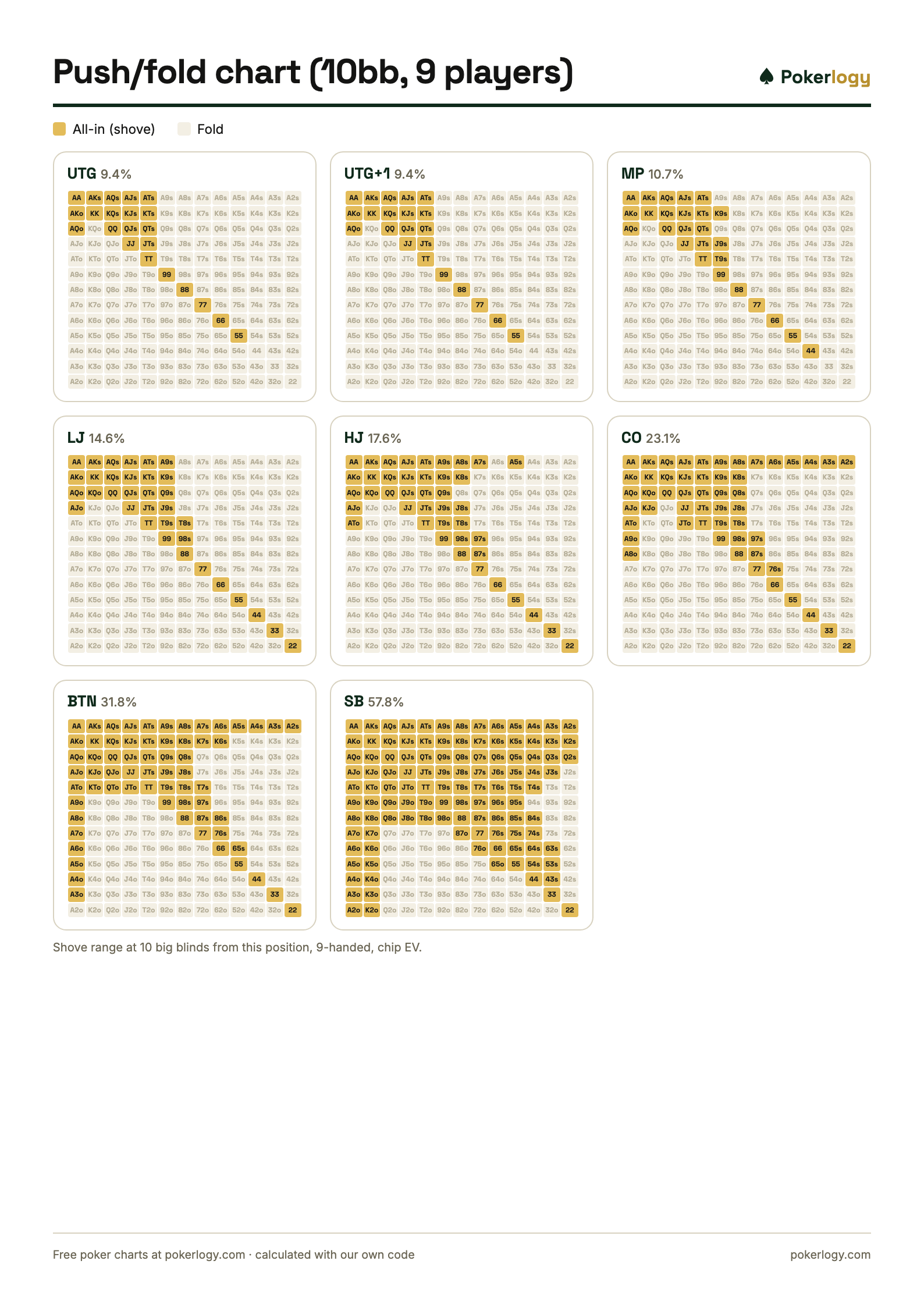
When your stack drops to 15 big blinds or fewer, poker gets simpler. A normal raise would commit a large part of your chips anyway, so the best strategy before the flop becomes: go all-in or fold. This push fold chart shows exactly which hands to shove from every seat at a nine-handed table, for stacks from 2 to 20 big blinds, with or without a big blind ante. The ranges are a Nash equilibrium that we computed ourselves.
| AA | AKs | AQs | AJs | ATs | A9s | A8s | A7s | A6s | A5s | A4s | A3s | A2s |
| AKo | KK | KQs | KJs | KTs | K9s | K8s | K7s | K6s | K5s | K4s | K3s | K2s |
| AQo | KQo | QJs | QTs | Q9s | Q8s | Q7s | Q6s | Q5s | Q4s | Q3s | Q2s | |
| AJo | KJo | QJo | JJ | JTs | J9s | J8s | J7s | J6s | J5s | J4s | J3s | J2s |
| ATo | KTo | QTo | JTo | TT | T9s | T8s | T7s | T6s | T5s | T4s | T3s | T2s |
| A9o | K9o | Q9o | J9o | T9o | 99 | 98s | 97s | 96s | 95s | 94s | 93s | 92s |
| A8o | K8o | Q8o | J8o | T8o | 98o | 88 | 87s | 86s | 85s | 84s | 83s | 82s |
| A7o | K7o | Q7o | J7o | T7o | 97o | 87o | 77 | 76s | 75s | 74s | 73s | 72s |
| A6o | K6o | Q6o | J6o | T6o | 96o | 86o | 76o | 66 | 65s | 64s | 63s | 62s |
| A5o | K5o | Q5o | J5o | T5o | 95o | 85o | 75o | 65o | 55 | 54s | 53s | 52s |
| A4o | K4o | Q4o | J4o | T4o | 94o | 84o | 74o | 64o | 54o | 44 | 43s | 42s |
| A3o | K3o | Q3o | J3o | T3o | 93o | 83o | 73o | 63o | 53o | 43o | 33 | 32s |
| A2o | K2o | Q2o | J2o | T2o | 92o | 82o | 72o | 62o | 52o | 42o | 32o | 22 |
Download for free
No e-mail, no account. Print it or keep it on your phone.
How do you use a push/fold chart?
- Count your stack in big blinds. Divide your chips by the size of the big blind. With 12,000 chips and blinds of 600/1,200, you have 10 big blinds. If every opponent still to act has fewer chips than you, use the biggest of their stacks instead: you can never win or lose more than the smaller stack in an all-in.
- Find your seat. Click your position. The chart assumes everyone before you has folded.
- Set the stack and the ante. Move the slider to your stack and choose “No ante” or “Big blind ante”.
- Shove or fold. If your hand is gold, move all-in. If it is dark, fold. There is no third option.
At a 6-max table, count the players left to act after you and use the seat with the same number behind: the 6-max under the gun player has five players behind, like the lojack (LJ) in the chart; the hijack, cutoff, button and small blind are the same in both formats.
How many hands should you shove from each seat?
The share of hands that the equilibrium shoves grows quickly as you get closer to the button and as your stack gets shorter. Without an ante:
| Seat (no ante) | 5bb | 10bb | 15bb | 20bb |
|---|---|---|---|---|
| UTG | 14.3% | 9.4% | 5.7% | 3.8% |
| UTG+1 | 16.4% | 9.4% | 6.5% | 4.4% |
| MP | 18.9% | 10.7% | 8.3% | 5.3% |
| LJ | 22.8% | 14.6% | 9.4% | 7.4% |
| HJ | 27.3% | 17.6% | 12.4% | 9.4% |
| CO | 33.0% | 23.1% | 17.0% | 12.8% |
| BTN | 40.6% | 31.8% | 25.2% | 19.8% |
| SB | 71.9% | 57.8% | 46.0% | 39.7% |
With a big blind ante of one big blind, which is now standard in most tournaments:
| Seat (BB ante) | 5bb | 10bb | 15bb | 20bb |
|---|---|---|---|---|
| UTG | 32.7% | 13.0% | 9.4% | 7.4% |
| UTG+1 | 33.0% | 15.8% | 10.4% | 9.4% |
| MP | 34.8% | 17.0% | 13.7% | 10.1% |
| LJ | 37.9% | 20.7% | 16.4% | 12.4% |
| HJ | 40.9% | 27.6% | 20.1% | 15.2% |
| CO | 46.6% | 33.0% | 25.8% | 21.3% |
| BTN | 56.9% | 41.2% | 35.4% | 32.4% |
| SB | 79.2% | 62.6% | 55.1% | 47.2% |
Two examples at 10 big blinds without an ante. Under the gun, with eight players behind, you shove only 55+, ATs+, KTs+, QTs+, JTs, AQo+ (9.4%). On the button, with only the blinds left, you shove 22+, A2s+, K6s+, Q8s+, J8s+, T7s+, 97s+, 86s+, 76s, 65s, A3o+, KTo+, QTo+, JTo (31.8%). In the small blind, facing only the big blind, it is 57.8%, exactly the heads-up result below.
Why does an ante make you shove more hands?
An ante puts extra chips in the middle before anyone acts. With a big blind ante, the pot you win when everyone folds grows from 1.5 to 2.5 big blinds, so every shove that steals the blinds is worth two thirds more. The callers also get a better price, but the gain from folds dominates. Compare the two tables: at 10 big blinds the button goes from 31.8% to 41.2%, and under the gun from 9.4% to 13.0%. If your game has antes, always use the ante setting: the no-ante chart would make you fold far too many profitable shoves.
How do you read the heads-up push/fold chart?
Heads-up, with only the small blind and the big blind in the hand, is the cleanest case: the small blind shoves or folds, the big blind calls or folds. Here we computed the exact equilibrium. Instead of one chart per stack, each cell shows the largest stack (in big blinds) at which the hand is still a shove for the small blind, or a call for the big blind. Switch between “Small blind: shove” and “Big blind: call”.
| AA25+ | AKs25+ | AQs25+ | AJs25+ | ATs25+ | A9s25+ | A8s25+ | A7s25+ | A6s25+ | A5s25+ | A4s25+ | A3s25+ | A2s25+ |
| AKo25+ | KK25+ | KQs25+ | KJs25+ | KTs25+ | K9s25+ | K8s25+ | K7s25+ | K6s25+ | K5s25+ | K4s24.5 | K3s20.5 | K2s18.5 |
| AQo25+ | KQo25+ | QQ25+ | QJs25+ | QTs25+ | Q9s25+ | Q8s25+ | Q7s25+ | Q6s25+ | Q5s24 | Q4s18 | Q3s13 | Q2s12.5 |
| AJo25+ | KJo25+ | QJo25+ | JJ25+ | JTs25+ | J9s25+ | J8s25+ | J7s25+ | J6s17 | J5s15 | J4s12 | J3s10.5 | J2s9 |
| ATo25+ | KTo25+ | QTo25+ | JTo25+ | TT25+ | T9s25+ | T8s25+ | T7s25+ | T6s25+ | T5s11 | T4s10.5 | T3s8.5 | T2s6 |
| A9o25+ | K9o19.5 | Q9o14.5 | J9o24 | T9o25+ | 9925+ | 98s25+ | 97s25+ | 96s25+ | 95s21 | 94s6.5 | 93s5 | 92s4 |
| A8o25+ | K8o15.5 | Q8o12 | J8o11 | T8o16.5 | 98o21.5 | 8825+ | 87s25+ | 86s25+ | 85s24 | 84s12 | 83s2.5 | 82s2.5 |
| A7o25+ | K7o15 | Q7o9 | J7o7.5 | T7o7 | 97o9.5 | 87o18 | 7725+ | 76s25+ | 75s25+ | 74s18 | 73s2.5 | 72s2 |
| A6o25+ | K6o14 | Q6o9 | J6o6 | T6o5.5 | 96o4.5 | 86o5.5 | 76o14.5 | 6625+ | 65s25+ | 64s24.5 | 63s11 | 62s2 |
| A5o25+ | K5o12.5 | Q5o8.5 | J5o5.5 | T5o4 | 95o3.5 | 85o2.5 | 75o2.5 | 65o10 | 5525+ | 54s25+ | 53s17 | 52s2 |
| A4o25+ | K4o11.5 | Q4o7.5 | J4o5 | T4o3.5 | 94o2.5 | 84o2 | 74o2 | 64o2 | 54o2 | 4425+ | 43s12.5 | 42s1.5 |
| A3o25+ | K3o11 | Q3o7 | J3o4.5 | T3o3 | 93o2.5 | 83o2 | 73o1.5 | 63o1.5 | 53o1.5 | 43o1.5 | 3325+ | 32s1.5 |
| A2o24.5 | K2o10.5 | Q2o6.5 | J2o4.5 | T2o3 | 92o2 | 82o1.5 | 72o1.5 | 62o1.5 | 52o1.5 | 42o1 | 32o1 | 2225+ |
Reading it is simple: if your stack is at or below the number in the cell, shove (or call); if it is above, fold. The numbers are smoothed thresholds, explained below. “25+” means the hand is a shove or call at every stack up to 25 big blinds, the deepest we calculated. A few examples without an ante:
| Hand | Small blind shoves up to | Big blind calls up to |
|---|---|---|
| 2-2 | 25+ | 15.5bb |
| A-2 offsuit | 24.5bb | 14bb |
| K-9 offsuit | 19.5bb | 17bb |
| K-2 offsuit | 10.5bb | 7.5bb |
| Q-2 offsuit | 6.5bb | 5bb |
| 10-9 offsuit | 25+ | 8.5bb |
| 7-2 offsuit | 1.5bb | 2.5bb |
Look at 10-9 offsuit: a shove at any stack in the chart, but a call only up to 8.5 big blinds. And at the very bottom, 7-2 offsuit is a call up to 2.5 big blinds but a shove only up to 1.5. With a tiny stack the big blind is getting such a good price that it calls with almost anything.
At 10 big blinds, the small blind shoves 57.8% of hands and the big blind calls with 37.6%. The numbers in the cells are smoothed thresholds: for each hand we chose the single stack size that best separates the stacks where the equilibrium shoves (or calls) from those where it folds. The true Nash solution has a few small gaps at very short stacks, where a hand such as 5-3 suited folds for a moment before becoming a shove again, and a few borderline hands near their limit are close to indifferent. The difference in chips is tiny, and one number per hand is far easier to learn.
Why are calling ranges tighter than shoving ranges?
Because the shover has two ways to win and the caller only one. When you shove, you win immediately whenever everyone folds; that is your fold equity. Only when someone calls do you need the best hand. The caller has no fold equity at all: calling an all-in means a showdown, so the hand must be strong enough against the shoving range on its own.
That is why the gap is so large. At 10 big blinds heads-up, the small blind shoves 57.8% but the big blind calls only 37.6%, even though the big blind already has a big blind in the pot. A useful rule for beginners: you need a better hand to call an all-in than to make one.
When should you switch to push/fold?
As a rough guide:
- Below about 10 big blinds: push/fold is the main strategy from every seat. A min-raise and fold would throw away too much of your stack.
- 10 to 15 big blinds: push/fold is the standard for most players, especially from late position and the small blind.
- 15 to 20 big blinds: strong players mix in normal open-raises, particularly from early seats, and reserve shoves for spots like re-shoving over someone else’s open. The chart still tells you which hands are strong enough to commit.
- Above 20 big blinds: go back to the open-raise charts in preflop charts.
Why is ICM a reason to shove less?
Our ranges use chip EV: every chip is worth the same. In a tournament that is not true near the payouts. Busting means you win nothing more, while doubling up does not double your prize. This effect is called ICM (Independent Chip Model). Near the bubble, at pay jumps and at the final table, both shoving and especially calling ranges should be tighter than our chart, often much tighter for medium stacks. Early in a tournament, far from the money, the chip EV chart is a good guide.
How were these ranges built?
The push/fold ranges are a chip-EV Nash equilibrium that we computed from our 169×169 all-in equity matrix (30,000 simulated deals for every pair of hands, open-source eval7 evaluator). A Nash equilibrium is a pair of strategies where neither player can gain by changing theirs: the shoving range is the best answer to the calling range, and the calling range is the best answer to the shoving range.
- Heads-up: the exact equilibrium between small blind and big blind for stacks from 1 to 25 big blinds in steps of half a big blind, found with fictitious play (each side repeatedly plays the best answer to the other side’s average strategy until both settle; 1,500 rounds per stack). Each hand then gets one smoothed stack threshold: shove (or call) at or below it, fold above it. Check: at 10 big blinds the small blind shoves 57.8% and the big blind calls 37.6%, matching published Nash values.
- Nine-handed table: an approximation. The players behind you call optimally against your shoving range, and you shove optimally against their calling ranges. Multiway all-ins (two or more callers) and card removal (the cards you hold change what others can have) are ignored, and the equilibrium was found with the same fictitious-play method (800 rounds). Each hand again gets one smoothed stack threshold, every later seat shoves at least everything an earlier seat shoves, and the small blind’s range is the heads-up result. Treat the edges of each range as approximate.
- Ante: the big blind ante is one big blind, paid by the big blind and dead in the pot.
- No ICM: tournament payouts are not modelled. Near the bubble and at final tables, ranges get tighter.
Deviate when the assumptions do not hold: shove wider against players who call too little, tighter against players who call too much, and much tighter under ICM pressure. Updated 14 November 2026.
What do players ask most often?
What does Nash push/fold mean?
A pair of strategies, one for shoving and one for calling, where neither player can do better by changing their own. If you shove the Nash range, no calling strategy can exploit you. It is the poker version of the game theory equilibrium described on our GTO charts page.
At how many big blinds should I start shoving?
Push/fold becomes the main strategy at about 10 to 15 big blinds and below. Between 15 and 20 big blinds, open-raising is common and shoves are mostly reserved for re-shoving over other players.
Should I call an all-in with the same hands I would shove?
No. Calling ranges are much tighter, because a caller has no fold equity. Heads-up at 10 big blinds the small blind shoves 57.8% of hands, while the big blind calls with 37.6%.
Does the chart work for sit and go tournaments?
Early on, yes. As the sit and go approaches the paid places, ICM matters a lot, and you should shove and especially call tighter than the chart.
Can I use it in cash games?
Cash games are usually played with 100 big blinds, where push/fold is far from optimal. Use the preflop charts instead.