Preflop is where most poker decisions are made, and where most beginners lose the most chips: they play too many hands from the wrong seats. A preflop chart fixes that. It shows, for every one of the 169 starting hands, what to do when the action reaches you: raise, call or fold. Below you will find our open-raise charts for 6-max and full ring tables, a chart for when someone has already raised, and a link to push/fold charts for short stacks. Click a position to see its range.
| AA | AKs | AQs | AJs | ATs | A9s | A8s | A7s | A6s | A5s | A4s | A3s | A2s |
| AKo | KK | KQs | KJs | KTs | K9s | K8s | K7s | K6s | K5s | K4s | K3s | K2s |
| AQo | KQo | QJs | QTs | Q9s | Q8s | Q7s | Q6s | Q5s | Q4s | Q3s | Q2s | |
| AJo | KJo | QJo | JJ | JTs | J9s | J8s | J7s | J6s | J5s | J4s | J3s | J2s |
| ATo | KTo | QTo | JTo | TT | T9s | T8s | T7s | T6s | T5s | T4s | T3s | T2s |
| A9o | K9o | Q9o | J9o | T9o | 99 | 98s | 97s | 96s | 95s | 94s | 93s | 92s |
| A8o | K8o | Q8o | J8o | T8o | 98o | 88 | 87s | 86s | 85s | 84s | 83s | 82s |
| A7o | K7o | Q7o | J7o | T7o | 97o | 87o | 77 | 76s | 75s | 74s | 73s | 72s |
| A6o | K6o | Q6o | J6o | T6o | 96o | 86o | 76o | 66 | 65s | 64s | 63s | 62s |
| A5o | K5o | Q5o | J5o | T5o | 95o | 85o | 75o | 65o | 55 | 54s | 53s | 52s |
| A4o | K4o | Q4o | J4o | T4o | 94o | 84o | 74o | 64o | 54o | 44 | 43s | 42s |
| A3o | K3o | Q3o | J3o | T3o | 93o | 83o | 73o | 63o | 53o | 43o | 33 | 32s |
| A2o | K2o | Q2o | J2o | T2o | 92o | 82o | 72o | 62o | 52o | 42o | 32o | 22 |
Open-raise: 66+, A5s+, K9s+, QTs+, J9s+, T9s, ATo+, KJo+
Download for free
No e-mail, no account. Print it or keep it on your phone.
How do you read a preflop action chart?
The grid is the same 13×13 layout as our starting hands chart. Pocket pairs run along the diagonal from A-A in the top left to 2-2 in the bottom right. Suited hands (marked “s”) sit above the diagonal and offsuit hands (marked “o”) below it. Find your first card in the row and your second in the column.
The colour tells you the action:
- Gold means open-raise (or 3-bet, when someone has raised before you).
- Green means call. It only appears in the charts for facing a raise.
- Dark means fold.
Under the grid you see what share of all hands the range contains. This counts combinations, not cells: a pair can be dealt in 6 ways, a suited hand in 4 and an offsuit hand in 12, out of 1,326 in total. The 6-max under the gun range has 33 gold cells but only 198 combinations, which is 14.9% of all hands.
The range is also written as a range string, the shorthand used in poker books and study software. “66+” means sixes or better, “A5s+” means A-5 suited up to A-K suited, “T8s+” means T-8 suited and T-9 suited (T stands for ten). The copy button puts the string on your clipboard, so you can paste it into an equity calculator or your notes.
What are the opening ranges at a 6-max table?
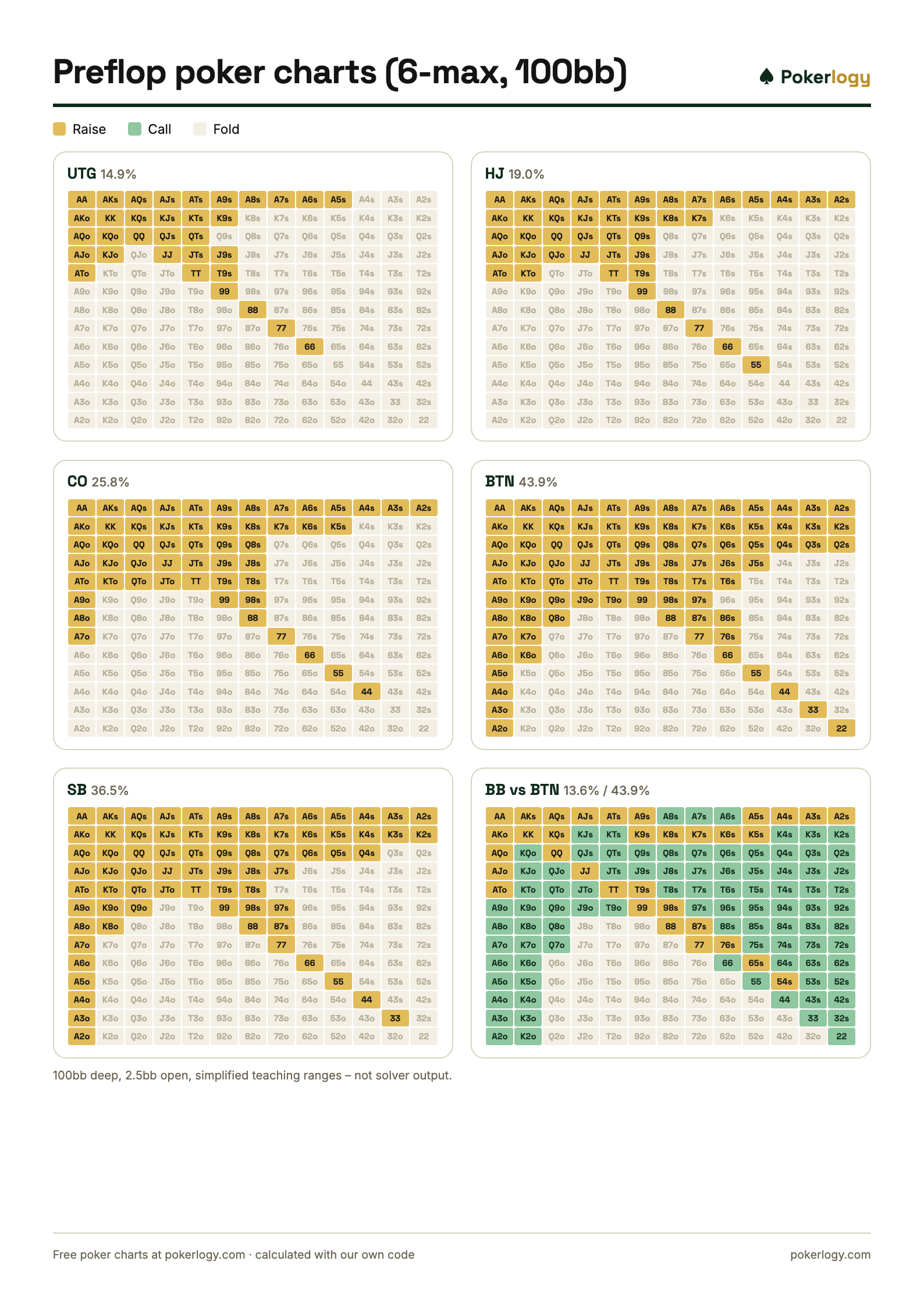
An open-raise (also called RFI, “raise first in”) is your move when everyone before you has folded. Our chart assumes you raise to 2.5 big blinds. These are the ranges by seat:
| Seat (6-max) | Hands opened | Range |
|---|---|---|
| UTG (under the gun) | 14.9% | 66+, A5s+, K9s+, QTs+, J9s+, T9s, ATo+, KJo+ |
| HJ (hijack) | 19.0% | 55+, A2s+, K7s+, Q9s+, J9s+, T9s, ATo+, KTo+, QJo |
| CO (cutoff) | 25.8% | 44+, A2s+, K5s+, Q8s+, J8s+, T8s+, 98s, A7o+, KTo+, QTo+, JTo |
| BTN (button) | 43.9% | 22+, A2s+, K2s+, Q2s+, J5s+, T6s+, 97s+, 86s+, 76s, A2o+, K6o+, Q8o+, J9o+, T9o |
| SB (small blind) | 36.5% | 33+, A2s+, K2s+, Q4s+, J7s+, T8s+, 97s+, 87s, A2o+, K8o+, Q9o+, JTo |
The pattern is simple: the fewer players left to act behind you, the more hands you open. Under the gun, five players can still wake up with a strong hand. On the button, only the two blinds are left, and you will act last on every later street. The big blind has no open-raise chart, because when everyone folds to it, the hand is over.
What are the opening ranges at a full ring table?
At a nine-handed table there are three more seats in front, so the early ranges are tighter. Switch between the positions to see how the range grows from 10.9% under the gun to 43.9% on the button.
| AA | AKs | AQs | AJs | ATs | A9s | A8s | A7s | A6s | A5s | A4s | A3s | A2s |
| AKo | KK | KQs | KJs | KTs | K9s | K8s | K7s | K6s | K5s | K4s | K3s | K2s |
| AQo | KQo | QJs | QTs | Q9s | Q8s | Q7s | Q6s | Q5s | Q4s | Q3s | Q2s | |
| AJo | KJo | QJo | JJ | JTs | J9s | J8s | J7s | J6s | J5s | J4s | J3s | J2s |
| ATo | KTo | QTo | JTo | TT | T9s | T8s | T7s | T6s | T5s | T4s | T3s | T2s |
| A9o | K9o | Q9o | J9o | T9o | 99 | 98s | 97s | 96s | 95s | 94s | 93s | 92s |
| A8o | K8o | Q8o | J8o | T8o | 98o | 88 | 87s | 86s | 85s | 84s | 83s | 82s |
| A7o | K7o | Q7o | J7o | T7o | 97o | 87o | 77 | 76s | 75s | 74s | 73s | 72s |
| A6o | K6o | Q6o | J6o | T6o | 96o | 86o | 76o | 66 | 65s | 64s | 63s | 62s |
| A5o | K5o | Q5o | J5o | T5o | 95o | 85o | 75o | 65o | 55 | 54s | 53s | 52s |
| A4o | K4o | Q4o | J4o | T4o | 94o | 84o | 74o | 64o | 54o | 44 | 43s | 42s |
| A3o | K3o | Q3o | J3o | T3o | 93o | 83o | 73o | 63o | 53o | 43o | 33 | 32s |
| A2o | K2o | Q2o | J2o | T2o | 92o | 82o | 72o | 62o | 52o | 42o | 32o | 22 |
Open-raise: 77+, A7s+, K9s+, QTs+, JTs, T9s, AJo+
From the cutoff onwards, the full ring and 6-max charts are identical, because the situation is the same: three players behind you in the cutoff, two on the button, one in the small blind. The 6-max under the gun seat has as many players behind it as the full ring lojack: five. Our two sets use slightly different target widths for it (14.9% and 17.0%), but the logic is the same. If you play at a table with seven or eight players, count the players left to act after you and use the seat with the same number behind. For a seat-by-seat explanation, see poker opening ranges by position.
What should you do when someone raises before you?
Once a player has opened, the open-raise chart no longer applies. Now you have three options: 3-bet (re-raise), call or fold, and your range must be much tighter, because the opener has already shown strength. Here is the button facing a cutoff open:
| AA | AKs | AQs | AJs | ATs | A9s | A8s | A7s | A6s | A5s | A4s | A3s | A2s |
| AKo | KK | KQs | KJs | KTs | K9s | K8s | K7s | K6s | K5s | K4s | K3s | K2s |
| AQo | KQo | QJs | QTs | Q9s | Q8s | Q7s | Q6s | Q5s | Q4s | Q3s | Q2s | |
| AJo | KJo | QJo | JJ | JTs | J9s | J8s | J7s | J6s | J5s | J4s | J3s | J2s |
| ATo | KTo | QTo | JTo | TT | T9s | T8s | T7s | T6s | T5s | T4s | T3s | T2s |
| A9o | K9o | Q9o | J9o | T9o | 99 | 98s | 97s | 96s | 95s | 94s | 93s | 92s |
| A8o | K8o | Q8o | J8o | T8o | 98o | 88 | 87s | 86s | 85s | 84s | 83s | 82s |
| A7o | K7o | Q7o | J7o | T7o | 97o | 87o | 77 | 76s | 75s | 74s | 73s | 72s |
| A6o | K6o | Q6o | J6o | T6o | 96o | 86o | 76o | 66 | 65s | 64s | 63s | 62s |
| A5o | K5o | Q5o | J5o | T5o | 95o | 85o | 75o | 65o | 55 | 54s | 53s | 52s |
| A4o | K4o | Q4o | J4o | T4o | 94o | 84o | 74o | 64o | 54o | 44 | 43s | 42s |
| A3o | K3o | Q3o | J3o | T3o | 93o | 83o | 73o | 63o | 53o | 43o | 33 | 32s |
| A2o | K2o | Q2o | J2o | T2o | 92o | 82o | 72o | 62o | 52o | 42o | 32o | 22 |
3-bet: TT+, AJs+, A5s-A2s, K9s-K5s, AQo+
Call: 99-22, ATs-A6s, KTs+, QTs+, J9s+, AJo-ATo, KJo+
The button 3-bets 7.7% of hands (TT+, AJs+, A5s-A2s, K9s-K5s, AQo+) and calls another 10.9% (99-22, ATs-A6s, KTs+, QTs+, J9s+, AJo-ATo, KJo+). Everything else, 81.4% of hands, is a fold. Compare that with the 43.9% the button opens when nobody has raised: the same seat, a completely different chart. Use the drop-down to see all 15 situations, and read 3-bet ranges to learn why some suited aces 3-bet while stronger-looking hands just call.
What about short stacks and push/fold?
These charts are built for 100 big blinds. With 15 big blinds or fewer, which is common in tournaments, a normal raise commits too much of your stack, and the best strategy becomes all-in or fold. For that, use our push/fold chart: with 10 big blinds on the button and no ante, for example, the equilibrium shoves 31.8% of hands.
How can you memorise preflop charts?
Do not try to learn 169 cells per seat by heart. Learn the patterns, then the few hands each seat adds.
Which patterns do the 6-max charts share?
- Pocket pairs. Pairs are opened from 66 up under the gun, from 55 in the hijack, from 44 in the cutoff and all of them on the button. The small blind stops at 33.
- Suited aces. From the hijack onwards every suited ace is an open. Under the gun the chart stops at A5s.
- Broadways. Two cards ten or higher. Suited broadways are always in; offsuit broadways are added step by step: A-K to A-10 and K-Q, K-J under the gun, then KTo and QJo, then QTo and JTo.
- Suited before offsuit. At every seat, every offsuit hand in the range has its suited version in the range too. Under the gun the range has 18 suited hands and only 6 offsuit ones.
- Nested ranges. From under the gun to the button, each seat keeps the whole range of the seat before it and only adds hands, so you never fold in a later seat a hand you would open earlier.
Which hands does each 6-max seat add?
- UTG to hijack (+9 hands, 54 combinations): 55, A4s, A3s, A2s, K8s, K7s, Q9s, KTo, QJo.
- Hijack to cutoff (+12 hands, 90 combinations): 44, K6s, K5s, Q8s, J8s, T8s, 98s, A9o, A8o, A7o, QTo, JTo.
- Cutoff to button (+33 hands, 240 combinations): 33, 22, K4s-K2s, Q7s-Q2s, J7s-J5s, T7s, T6s, 97s, 87s, 86s, 76s, A6o-A2o, K9o-K6o, Q9o, Q8o, J9o and T9o.
The button step is by far the biggest: the range grows by about 70%, from 342 to 582 combinations. Note what it is made of: weak offsuit aces and kings, which win when the blinds fold or miss, and more small suited hands that play well in position.
The small blind (36.5%) uses a subset of the button range: our model ranks hands the same way as on the button and simply cuts the list shorter. It keeps the high-card hands, such as A2o and K8o, and drops the weakest button hands: 22, K7o, K6o, Q8o, J9o, T9o, Q3s, Q2s, J6s, J5s, T7s, T6s, 86s and 76s. From the small blind you will be out of position against the big blind for the rest of the hand, so the marginal hands that need position go first.
To practise, deal yourself random hands, say the action for a random seat out loud, then check the chart.
When should you deviate from a preflop chart?
A chart is a starting point for a standard situation. Change it when the situation changes:
- Stack depth. With much more than 100 big blinds, small pairs and suited connectors gain value through implied odds. With 20-40 big blinds, they lose it and high cards gain. Below about 15 big blinds, switch to push/fold.
- Antes. An ante makes the pot bigger before anyone acts, so stealing the blinds pays more and every seat should open wider.
- Rake. Our model has no rake. A high rake hurts small pots, so it favours tighter calling and 3-betting over flatting.
- Live games with limpers. These charts assume everyone before you folded. If players limp in front of you, raise bigger with your strong hands and fold more of the marginal ones.
- Tournaments near the money. ICM (the value of tournament chips in prize money) makes losing a stack more costly, so ranges get tighter near the bubble and at the final table.
- Small suited connectors. Our simple model still folds 6-5 suited and 5-4 suited on the button, where many solver-based charts open them. Adding them to your button range is a reasonable change.
- Weak opponents. If the blinds fold too often, open wider. If a player calls everything, open tighter and value bet more.
How were these ranges built?
These are simplified teaching ranges from Pokerlogy’s own model, not solver output. They assume a cash game, 100 big blinds, an open-raise to 2.5 big blinds, no ante and no rake.
Open-raising: each hand gets a score made of two rankings from our simulation of 300,000 deals per hand (open-source eval7 evaluator): 55% its percentile by equity against one random hand and 45% its percentile by equity against as many random hands as there are players left behind you. To that we add a fixed playability bonus in percentile points: pairs +6, suited hands +5, suited connectors 12 more and one-gappers 6 more, and −8 for offsuit hands whose lower card is below ten, which realise their equity poorly (−4 if one of the cards is an ace, as in A-9 offsuit). Then we take hands from the top until the range reaches a standard width for the seat: in 6-max UTG 15%, HJ 19%, CO 26%, BTN 44%, SB 36%; at full ring UTG 11%, UTG+1 12.5%, MP 14.5%, LJ 17%, HJ 20%, then the same as 6-max. The ranges are nested: each seat up to the button keeps the whole range of the seat before it and adds the next hands. The small blind uses the button’s ordering, cut at 36%. Because hands come in whole blocks of combinations, the final widths differ slightly, for example 43.9% instead of 44%.
Facing a raise: we computed each hand’s equity against the opener’s range from our 169×169 all-in equity matrix (30,000 deals for every pair of hands). The strongest hands 3-bet for value. Bluffs come only from A5s-A2s, then K9s-K5s, then suited connectors from T9s down to 54s; strong suited aces are value hands or calls, never bluffs. In position, the next hands by equity plus a small playability bonus call. The small blind 3-bets its best hands or folds, and the big blind defends by pot odds. Details are on the 3-bet page. Updated 14 November 2026.
What do players ask most often?
Can I use a preflop chart while I play?
At a home game, if the other players agree, nothing stops you. Most online poker rooms forbid charts and other real-time help while you are seated at a table, so check the rules of the site you use. Use the charts for study away from the table until the ranges become second nature.
Are these GTO preflop charts?
No. They come from a simplified model, not from a solver. Our GTO charts page explains the difference and shows the one part we did compute as a true equilibrium: heads-up push/fold.
Why does the button open A-2 offsuit but fold J-8 offsuit?
An ace makes the top pair or wins high-card showdowns against the blinds’ weak hands, and it blocks some of the aces they could 3-bet with. J-8 offsuit has neither the high card nor the suit, so it is dominated far more often.
Do the charts work for tournaments?
For deep stacks early in a tournament, roughly, but antes widen every range. With 20 big blinds or fewer, the push/fold chart is the better tool.